

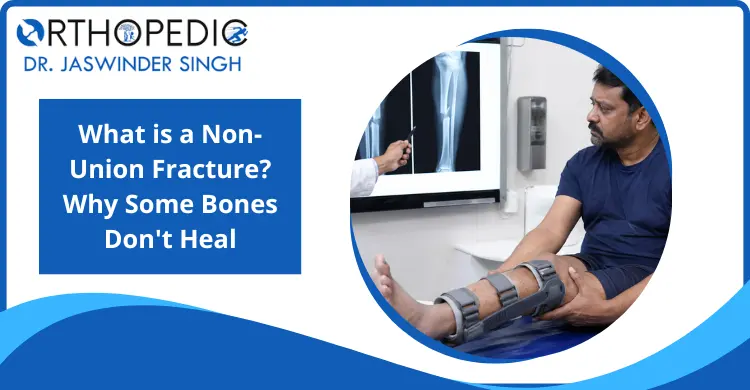
Most broken bones heal. With the right alignment and enough time, the body rebuilds the bone and the injury becomes a memory. But not every fracture follows that path. Some bones stop healing partway through, leaving a patient in pain months after the original injury.
When a broken bone fails to heal in the expected time, it is called a non-union fracture. It is one of the more frustrating problems in orthopedics, because an injury that should have healed simply does not.
This guide explains what a non-union fracture is, why some bones don’t heal, the warning signs to watch for, and how the problem is treated.
A non-union fracture is a broken bone that has stopped healing and is unlikely to join back together without treatment. Most fractures heal within a few months. When there is no meaningful healing within roughly six to nine months, or healing has clearly stalled, the fracture is classed as a non-union.
It is more common than many people expect. Research suggests that around 5 to 10 percent of fractures heal slowly or fail to heal properly. The risk is higher after serious injuries such as road accidents, which are a frequent cause of complex fractures in Bihar.
These three terms are often confused but mean different things:
Telling them apart matters, because each is managed differently.
Healing depends on three things: a good blood supply, enough stability, and healthy biology. When one or more of these is missing, the bone can struggle to heal. These are the most common reasons.
Bone needs a steady blood supply to deliver the cells and nutrients that rebuild it. When blood flow to the fracture is limited, healing slows or stops. This is the main reason behind atrophic non-union, where little new bone forms.
Bone ends need to be held still to knit together. If the fracture is not stabilized well enough, constant micro-movement prevents the healing tissue, called callus, from bridging the gap.
An infection at or around the fracture interferes with the healing process and damages local tissue. Infection is a common reason fractures fail to heal after open injuries, where the skin was broken.
Healing is not only local. Whole-body factors matter too. Smoking, diabetes, certain medications, and poor nutrition all reduce the body’s ability to repair bone and raise the risk of non-union.
High-energy injuries that shatter the bone into several pieces, or open fractures where bone breaks through the skin, carry a higher risk. Bone loss and soft-tissue damage make healing harder.
Non-unions are generally grouped into two patterns. A hypertrophic non-union has a good blood supply but too much movement, so the body forms extra bone at the edges without bridging the gap. An atrophic non-union has a poor blood supply and little new bone formation. Knowing which type is present helps the surgeon plan the right treatment.
The clearest sign of a non-union is pain that continues long after the fracture should have healed. Other symptoms include:
If a healed fracture still hurts months later, it is worth having it checked. Our guide on the five stages of fracture recovery explains how normal healing should progress.
Diagnosis is based on time and imaging. A specialist reviews the injury history and takes X-rays over a period of weeks or months. When the X-rays show no sign of healing progress, a non-union is likely. A CT scan is sometimes used to confirm the diagnosis and measure the gap between the bone ends, which helps with planning.
The goal of treatment is to restore the conditions the bone needs to heal: stability, blood supply, and biology. Depending on the cause and type, options include:
For difficult cases, the Ilizarov technique can stabilize the bone and encourage healing while also correcting deformity or replacing lost bone. The right approach depends on each individual case and is decided after careful assessment.
A non-union does not improve on its own once healing has stalled. Left untreated, it can lead to chronic pain, deformity, muscle weakness, and long-term loss of function in the limb. Early specialist assessment gives the bone the best chance to heal and helps avoid bigger problems later. If you have a fracture that has not healed, book your consultation for a clear evaluation.
Treating a bone that has refused to heal takes careful planning and experience in complex trauma. Dr. Jaswinder Singh holds MBBS, MS, DNB, and MCh qualifications along with DSICOT (Belgium) and MRCSA (Glasgow) international fellowships, with a focus on deformity correction and complex trauma. At Orthovita Hospital, Bailey Road, Patna, patients have access to detailed evaluation, advanced imaging, and reconstruction options under one roof. You can learn more about the full range of bone fracture and trauma treatment available.
A fracture is usually considered a non-union when there is no meaningful healing after about six to nine months, or when healing has clearly stopped on repeated X-rays.
Once healing has stalled, a non-union rarely heals without treatment. In most cases, surgery or another intervention is needed to restore stability and stimulate new bone growth.
A delayed union is healing slower than expected but still progressing. A non-union means healing has stopped and the bone will not join without treatment.
Diagnosis is based on the injury history and X-rays taken over time. When imaging shows no healing progress, a non-union is likely. A CT scan may confirm it.
Some early or stable cases may respond to non-surgical methods like bone stimulation. However, most established non-unions need surgery to add stability, blood supply, or a bone graft.
A non-union fracture can be discouraging, especially when an injury that should have healed still causes pain. The good news is that most non-unions can be treated successfully once the underlying cause is identified and addressed.
If you have a fracture that has not healed after several months, do not wait for it to improve on its own. Book your consultation at Orthovita Hospital, Bailey Road, Patna. Call +91-9234040989 or book your appointment online today.
This content is for general patient information only and does not replace a professional medical evaluation. Please consult a qualified orthopedic specialist for advice specific to your condition.