

Some patients live for years with a problem they were told could not be corrected — a shorter leg, a bone that never healed properly, or a deformity that affects walking and daily life. For these patients, the Ilizarov technique can be life-changing.
This is a specialised orthopaedic method used for bone lengthening, deformity correction, and difficult fracture healing problems. It is not a routine procedure, and it is not for every case. But when it is the right treatment, it can restore alignment, improve function, and help patients avoid bigger operations later.
If you are searching for an ilizarov technique surgeon in Patna, this guide explains what the procedure is, which problems it treats, what daily life with the frame feels like, how long treatment takes, and why specialist planning matters.
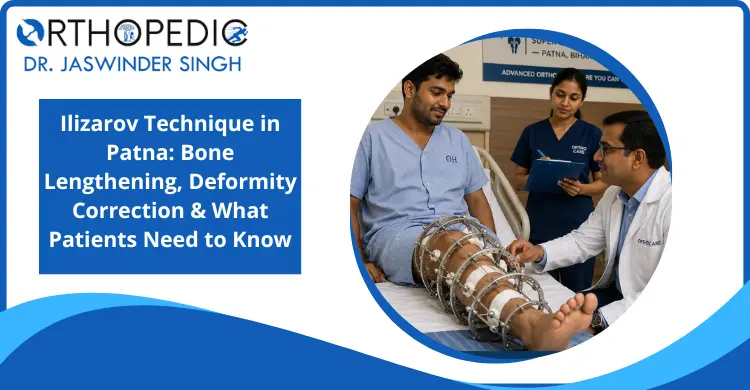
The Ilizarov technique uses a circular external frame made of metal rings, rods, and wires that are attached around the limb. The frame stays outside the body, but it works with the bone beneath it to gradually correct alignment or length.
It is used for:
The technique is powerful because it can correct problems that are too complex for standard plates or nails. It is especially useful when a bone is short, crooked, infected, or not healing properly.
The Ilizarov method works on a principle called distraction osteogenesis. In simple terms, when a bone is cut in a controlled way and then slowly pulled apart, the body responds by forming new bone in the gap.
The accepted rate of lengthening is usually about 1 mm per day, divided into smaller adjustments. That slow, controlled stretch gives the body time to build healthy new bone tissue.
This is the part that often surprises patients: the new bone is not artificial. It is your own bone, formed naturally by the body during treatment.
The Ilizarov technique is one of the most versatile tools in orthopaedic reconstruction. It is commonly used in patients who have been left with difficult problems after injury, infection, or growth-related deformity.
If one leg is shorter than the other, walking becomes uneven and the back, hip, and knee may start to ache over time. The Ilizarov frame can lengthen the shorter bone gradually until both sides are more balanced.
This is one of the most common reasons patients search for leg lengthening surgery in Patna.
Some deformities are not just about length. They may involve angulation, rotation, or a combination of both. Severe knock knees, bow legs, and deformity after fracture can all fall into this category.
In such cases, the Ilizarov frame can correct the alignment step by step. Patients looking for knock knee correction surgery in Patna may benefit from understanding how deformity correction changes depending on age and bone maturity.
You can also read our article on Common Orthopedic Conditions Treated by Specialists in Patna to understand how these problems are grouped and treated.
A non-union fracture is a bone that has failed to heal even after a long time. This is a significant problem after road accidents and severe injuries. The Ilizarov frame stabilises the bone and encourages healing by creating the right mechanical environment.
If you are trying to understand fracture healing problems in general, our article on Bone Fracture Symptoms: How to Identify and Treat a Broken Bone may help.
In some patients, infection destroys part of the bone and leaves a gap. The Ilizarov method can move healthy bone gradually across the defect while new bone forms behind it. This process is called bone transport.
These are complex cases and need specialist planning.
The first step is detailed assessment. At Orthovita Hospital, this usually includes examination, full-length standing X-rays, and sometimes CT scans for complex deformities. The surgeon measures the deformity, checks bone quality, and plans the correction carefully before surgery.
This is where the experience of a specialist matters. A good Ilizarov plan is not improvised in the operating room. It is mapped out in advance.
The operation is done under spinal or general anaesthesia. The bone is cut in a controlled way, and the circular frame is fixed to the limb using wires and rings. Most patients stay in the hospital for a short period after surgery.
The frame is designed to allow walking with support. In many cases, patients are encouraged to stand and move early because weight bearing helps stimulate bone healing.
This is the part many patients worry about most, but with proper guidance it becomes manageable.
During the distraction phase, the frame is adjusted little by little each day. The patient or family member is taught exactly how to do this before discharge. Daily pin-site cleaning is also essential to reduce infection risk.
Patients can usually walk with support such as crutches or a walker. Desk work and school may be possible after the initial recovery period, depending on the case.
The frame stays on while the new bone strengthens. That period is called consolidation. The frame is removed only after X-rays show that the new bone is solid enough.
After removal, physiotherapy becomes important again to restore strength, movement, and confidence.
The cost depends on the type of problem, the frame used, the length of treatment, and how much follow-up is needed.
A simple lengthening case costs less than a complex non-union or bone transport case. Hospital stay, imaging, physiotherapy, and repeated follow-up visits also affect the overall expense.
Because every case is different, the safest approach is to get a personal estimate after examination rather than rely on a fixed number online.
The Ilizarov technique is not a routine orthopaedic procedure. It requires advanced deformity correction planning, trauma experience, and careful follow-up.
Dr. Jaswinder Singh focuses on deformity correction, complex trauma, and paediatric orthopaedics, which makes him well suited to manage patients who need this kind of treatment. His training includes advanced orthopaedic exposure through DSICOT (Belgium) and MRCSA (Glasgow), along with specialist experience in deformity management.
At Orthovita Hospital, Patna, patients can get:
For patients from Patna and across Bihar, this means treatment can often begin locally without needing to travel far for a second opinion.
If you have also been diagnosed with a related deformity, our detailed guide on Knock Knee Correction Surgery in Patna may help you understand how corrective treatment is planned.
Yes. Walking with support is usually encouraged because it helps stimulate bone healing.
It depends on the condition. Some patients wear the frame for a few months, while complex cases may need longer.
The procedure is done under anaesthesia. After surgery, discomfort is managed with medication and proper guidance.
Patients with limb length discrepancy, non-union fractures, severe deformity, or bone loss may be candidates.
Pin-site infection is the most common minor issue, but it is usually manageable with proper care.
The Ilizarov technique has helped many patients who once believed their condition could not be fixed. It can lengthen bone, correct deformity, and even help bones that refused to heal.
For the right patient, it is one of the most effective ways to restore function and improve quality of life.
If you are looking for an ilizarov technique surgeon in Patna, specialist evaluation is the best next step.