

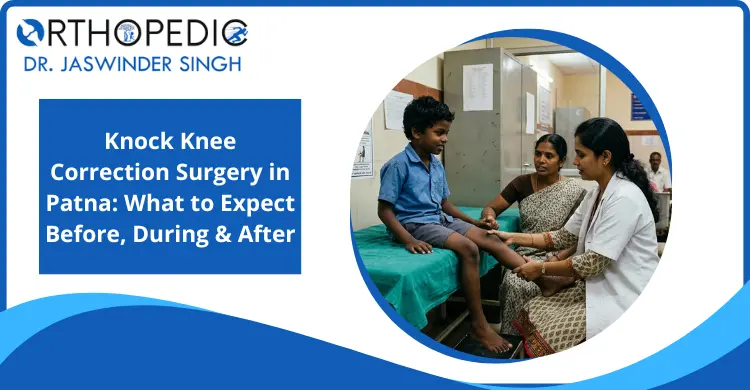
Knock knee correction surgery is often considered when a child’s legs continue to angle inward beyond the age when natural correction is expected, or when an adult begins to notice pain, walking difficulty, or worsening alignment. For many families, the first concern is not only whether surgery is necessary, but also what recovery will look like and whether the procedure is safe.
This guide explains genu valgum in simple terms, when surgery is considered, what happens before and during the procedure, and how recovery usually progresses. It is written for patients and families who are actively evaluating treatment options and want a clear, honest explanation before making a decision.
If you would like to speak with a specialist early in the process, you can book a consultation at Orthovita Hospital, Patna.
Knock knees, also called genu valgum, describe a leg alignment pattern where the knees angle inward and touch when standing, while the ankles remain apart. In young children, a mild degree of knock knees is often part of normal growth and may improve on its own. That is why not every child with inward-facing knees needs surgery.
Surgery becomes relevant when the deformity is persistent, worsening, or affecting function. In clinical practice, specialists often look at the tibiofemoral angle and the space between the ankles when the knees are touching. A tibiofemoral angle above 15 degrees or an intermalleolar distance above 8 cm may suggest a deformity that needs specialist assessment. In older children, persistent knock knees after the expected age of natural correction, or pain and walking difficulty in adults, should not be ignored.
Leaving significant knock knees untreated can place uneven stress on the knees, hips, and ankles. Over time, this may contribute to early joint wear, patellar instability, pain while walking or climbing stairs, and reduced confidence in movement.
In children, knock knees may be part of normal development, but persistent deformity can also be linked to rickets, vitamin D deficiency, obesity, or growth-related conditions such as Blount’s disease. In Bihar and nearby regions, nutritional bone problems are seen more often than many families expect, so an early evaluation is important when the deformity does not improve.
In adults, knock knees are usually related to long-standing alignment issues, arthritis, past injury, or progressive joint degeneration. Adults may first notice pain, a limp, or difficulty staying active for long periods.
A specialist opinion is advisable if you notice that the knees touch together but the ankles stay widely apart, the child avoids running or sports, the legs appear to be getting more uneven with time, or the patient complains of knee, hip, or ankle pain. If the deformity is interfering with daily movement, it is better to evaluate it early than to wait.
The best treatment depends on age, bone maturity, and how severe the deformity is. In younger children who still have growth remaining, guided growth is often considered. In adolescents and adults, osteotomy is usually the more appropriate option.
Guided growth surgery is used in children who still have open growth plates, often around the ages of 8 to 13. A small metal plate or staple is placed on one side of the growth plate near the knee. The other side continues growing normally, and this gradually straightens the leg over time. The correction is slow and natural, often taking several months.
This is a minimally invasive procedure and usually does not involve a large incision. Children are often able to walk soon after surgery, and the implant is removed once alignment has improved.
When growth is complete, guided growth is no longer effective. In that case, a corrective bone cut, called an osteotomy, is usually performed. The surgeon realigns the bone to restore a more balanced mechanical axis and then stabilizes it with plates and screws.
Depending on the degree and location of the deformity, correction may involve the femur, the tibia, or both. This is a well-established operation for older adolescents and adults with structural knock knees. When planned and performed correctly, it can improve alignment, reduce pain, and support better long-term joint mechanics.
For families seeking deformity correction surgery in Patna, this is where specialist experience matters. A surgeon who understands limb alignment, growth patterns, and reconstruction planning can match the treatment to the patient rather than forcing one solution for every case.
The first step is a detailed consultation. The doctor will examine the legs, ask about symptoms, review walking pattern, and order full-length standing X-rays of both lower limbs. These X-rays help measure the mechanical axis of the legs and show how much correction is needed.
At this stage, a patient-first approach is important. Surgery should be recommended only after discussing non-surgical options, the expected result, and the timing of treatment. In some cases, especially for younger children with mild deformity, observation or guided monitoring may be enough.
On the day of surgery, the patient is admitted to the hospital and prepared for anaesthesia. Depending on the procedure and patient age, the surgery may be done under general or spinal anaesthesia. A guided growth procedure is usually shorter and less complex than an osteotomy.
For osteotomy, the surgeon makes a controlled cut in the bone, corrects the alignment, and fixes the bone in its new position. The operation is typically completed in a single session, and the patient is monitored in recovery before shifting to the ward. Most osteotomy patients stay in the hospital for a short period, while guided growth may allow earlier discharge.
Recovery depends on the type of surgery, but the general pattern is similar. In the first few days, pain is managed with medication and gentle movement begins under supervision. During the first few weeks, crutches or partial weight bearing may be needed, and physiotherapy usually starts early to prevent stiffness.
By 6 to 12 weeks, swelling begins to reduce and weight bearing improves. Most patients gradually return to normal daily activities by 3 to 6 months, while bone healing continues to be confirmed on follow-up X-rays. Full healing may take longer in complex cases.
Physiotherapy is not optional after surgery. It is a key part of recovery and helps restore strength, balance, and confidence in walking.
If you are wondering whether knock knee correction surgery in Patna is the right step for your child or for yourself, this is the right point to speak with a specialist and review the X-rays together.
The cost of knock knee correction surgery in Patna varies based on the type of surgery, the severity of deformity, whether one or both legs are involved, the implant used, hospital stay, and the length of physiotherapy needed.
Guided growth is generally less expensive than osteotomy, since it is a smaller procedure. More complex corrections, especially those requiring longer hospital care or detailed rehabilitation, may cost more. Some patients may also be eligible for insurance or government health scheme support, depending on their coverage and the hospital’s empanelment.
A personalized estimate is best obtained after clinical assessment and review of imaging.
Patients looking for a bone deformity surgeon in Patna often want more than surgery alone. They want a doctor who understands whether the deformity is mild, growing, structural, or related to joint loading over time.
Dr. Jaswinder Singh brings advanced training in deformity correction and paediatric orthopaedics, along with experience in managing genu valgum in both children and adults. His training includes internationally recognized exposure to deformity correction techniques, which is especially valuable in planning procedures such as guided growth and osteotomy.
At Orthovita Hospital, Patna, patients receive assessment, imaging review, and treatment planning in one place. The focus is on practical outcomes: better alignment, safer movement, and a recovery plan that patients can follow with confidence.
Knock knees can be simple and temporary in some children, but in other cases they signal a structural problem that deserves specialist attention. The right diagnosis, the right timing, and the right procedure make a major difference in outcome.
If you are evaluating knock knee correction surgery in Patna, book your consultation with Dr. Jaswinder Singh to clarify whether surgery is needed now, whether a child can benefit from guided growth, or whether an adult needs osteotomy for long-term correction.
Medical Disclaimer: This article is intended for patient education only and does not replace a formal medical consultation. Treatment decisions should be made after clinical examination and imaging review by a qualified orthopaedic surgeon.