

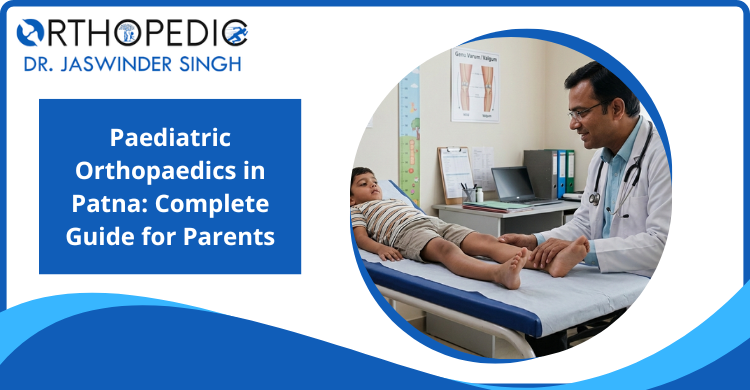
When a child limps, falls more often than peers, or a parent notices one leg looking shorter than the other, the instinct is to hope it corrects itself with time. Sometimes it does. Often, it doesn’t, and the window for the simplest, least invasive treatment quietly closes.
Children’s bones are not simply smaller adult bones. They have growth plates, different fracture patterns, unique healing capacity, and conditions that exist exclusively in childhood. Managing them well requires a specialist who understands not just bone surgery, but how children grow.
This guide covers the full scope of paediatric orthopaedics in Patna, the conditions Dr. Jaswinder Singh treats, when to seek specialist care, what treatment involves, and how parents can make informed decisions for their child’s bone health.
According to WHO musculoskeletal health data, musculoskeletal conditions account for nearly 50% of all childhood injuries. Yet the clinical management of a child’s fracture or bone deformity is genuinely different from an adult’s, in ways that make specialist knowledge essential, not optional.
Dr. Jaswinder Singh manages the full spectrum of paediatric orthopaedic conditions at Orthovita Hospital, Bailey Road, Patna. The following are the most commonly presenting conditions:
| Condition | What Parents Need to Know |
|---|---|
| Club Foot (CTEV) | One of the most common congenital foot deformities. In newborns, the Ponseti casting method (serial plaster casts) corrects most cases without surgery. Older children or resistant cases require operative correction. The Ponseti International Association endorses early treatment as the gold standard. |
| Bow Legs (Genu Varum) | Common in Bihar due to Vitamin D deficiency and nutritional rickets. Mild physiological bow legs in toddlers often self-correct. Persistent or progressive bowing beyond age 3 requires evaluation. Surgical correction via guided growth plates or osteotomy is highly effective. |
| Knock Knees (Genu Valgum) | Knees angle inward with the feet apart. Physiological in children aged 3–7, but persisting beyond age 7 or causing pain warrants specialist assessment. Knock knee correction surgery in Patna is one of the most commonly performed paediatric procedures in Dr. Singh’s practice. |
| Club Foot (Late Presenting) | Older children who did not receive treatment in infancy require surgical correction rather than casting. Late-presenting club foot is a specific area of Dr. Singh’s paediatric surgical practice. |
| Developmental Dysplasia of the Hip (DDH) | The hip socket fails to develop correctly. Detected early (under 6 months), it is treatable with a brace. Detected late, surgical correction is needed. The American Academy of Orthopaedic Surgeons recommends newborn screening. Untreated DDH is a leading cause of early hip arthritis. |
| Limb Length Discrepancy | One leg shorter than the other by 2 cm or more, causing a visible limp, compensatory spinal curvature, and uneven joint loading. Causes include growth plate injury, prior infection, or congenital factors. Leg lengthening or guided growth are the primary surgical options. |
| Growth Plate Fractures | Fractures through the growth plate (Salter-Harris fractures) are paediatric-specific injuries. Grades III–V require surgical fixation to prevent growth arrest. Mismanagement can permanently alter limb alignment and length. |
| Paediatric Fractures (General) | Children fracture bones differently from adults. Greenstick, buckle, and supracondylar fractures have distinct management protocols. Some require immediate specialist reduction; others are managed with casting the decision requires specialist paediatric orthopaedic assessment. |
| Scoliosis (Adolescent) | Abnormal lateral curvature of the spine, typically presenting in adolescence. Mild curves are monitored. Progressive curves may require bracing or, in severe cases, surgical correction. |
| Osteomyelitis (Bone Infection) | Bone infection in children requires prompt diagnosis and treatment. Delayed management causes bone destruction, growth plate damage, and long-term deformity. |
Most paediatric bone conditions are easier and cheaper to treat when identified early. These are the signs that should prompt a specialist consultation rather than continued monitoring at home.
A Note to Parents: ‘Wait and Watch’ Has Limits
A common and understandable instinct is to hope that a child’s bone issue will self-correct with growth. This is appropriate for some conditions in specific age ranges. For others, waiting beyond the treatment window converts a simple outpatient correction into a complex surgical procedure.
If any of the warning signs above are present, a consultation does not commit you to surgery. It gives you clarity, and in paediatric orthopaedics, that clarity early is genuinely valuable.
Accurate diagnosis is the foundation of every paediatric orthopaedic decision. At Orthovita Hospital, Bailey Road, Patna, the assessment process for a child is thorough, methodical, and adapted to the child’s age.
No surgical plan is made without a detailed consultation where findings are explained to the parent or guardian, all options are discussed, and realistic goals are agreed. For parents travelling from outside Patna, teleconsultation with imaging review is also available as a first step.
The right treatment depends entirely on the condition, the child’s age, and the stage of skeletal development. Paediatric orthopaedic treatment is not a one-size-fits-all domain, and the distinction between a child who needs surgery now versus one who can safely be monitored is one of the most important clinical judgements a specialist makes.
Paediatric orthopaedics is a dual competency. It requires both orthopaedic surgical expertise and an understanding of child-specific bone biology, growth, and development. Dr. Jaswinder Singh holds both.
For an overview of Dr. Singh’s full range of expertise and why families across Bihar consult him, see the best orthopedic doctor in Patna guide.
Dr. Jaswinder Singh offers specialist paediatric orthopaedic consultations at Orthovita Hospital, Bailey Road, Rukanpura, Patna.
+91-9234040989 | Book an Appointment
Any child with a persistent limp, visible bone deformity, unequal limb length, or abnormal gait after age 3 should be assessed without delay. For hip dysplasia or club foot, evaluation from birth is recommended.
Mild bow legs in toddlers under 2 are often physiological and resolve naturally. Bowing that persists beyond age 3, worsens progressively, or is associated with Vitamin D deficiency should be evaluated by a specialist in Patna.
Growth plate fractures occur at bone growth zones in children. Higher-grade injuries can arrest growth and cause permanent limb deformity if mismanaged. They require specialist paediatric orthopaedic assessment and often surgical fixation.
Yes. In newborns, the Ponseti casting technique corrects most club foot cases without surgery. Treatment must begin ideally within the first few weeks of life. Older or resistant cases may require operative correction.
DDH is a condition where the hip socket doesn’t develop correctly. Treated before 6 months with a brace, most cases resolve. Late diagnosis requires surgery. The American Academy of Orthopaedic Surgeons recommends newborn hip screening.
Children have growth plates, higher remodelling capacity, and unique fracture patterns absent in adults. Conditions like DDH, club foot, and guided growth procedures are exclusively paediatric, requiring specialist training beyond general orthopaedics.
This article has been written and reviewed by Dr. Jaswinder Singh (MBBS, MS, DNB, MCh, DSICOT Belgium, MRCSA Glasgow) for educational purposes only. It does not constitute medical advice, diagnosis, or a treatment recommendation. Individual medical conditions vary significantly between patients. Please consult Dr. Jaswinder Singh or a qualified orthopaedic surgeon before making any decision regarding your child’s health or treatment. Last reviewed: March 2026.