

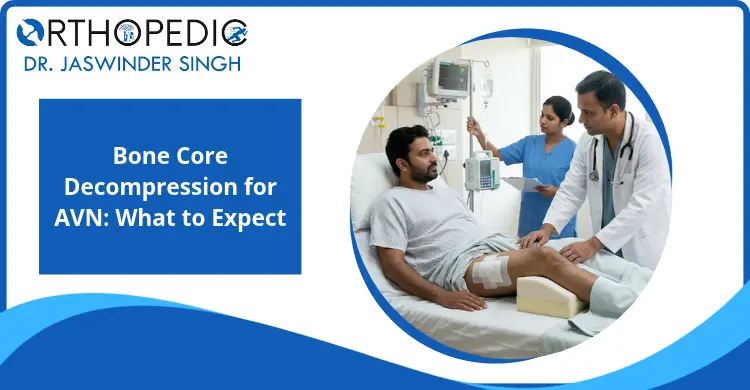
Hip pain in your 30s, 40s, or 50s is easy to dismiss. But when the cause is avascular necrosis (AVN), a condition where reduced blood supply damages the bone of the hip joint, timing matters. For selected patients in the early stages, core decompression for AVN is a joint-preserving procedure that aims to relieve pressure inside the bone and support healing before the joint surface collapses.
If you are weighing this option, this guide explains who it is meant for, what the procedure involves, and what recovery usually looks like, so you can arrive at your consultation with clear questions.
Core decompression for AVN is a surgical procedure for early disease of the femoral head, the ball of the hip joint. When blood flow to this area drops, bone cells die and the bone slowly weakens. If nothing changes, the surface can collapse and the joint may wear down.
The idea behind the procedure is simple. The surgeon removes a small core of bone from the affected area, which reduces pressure inside the bone and creates a channel that may encourage new blood vessels and healthy bone to grow. It does not reverse damage that has already happened, and results vary from patient to patient.
Core decompression is usually considered when AVN is found early, before the femoral head has collapsed. Your surgeon decides this using your symptoms, an examination, X-rays, and often an MRI scan. It may be discussed if:
If the femoral head has already collapsed or advanced arthritis has set in, core decompression is less likely to help. In those cases, a surgeon may talk to you about hip replacement instead. Only a proper evaluation can tell you which stage you are in.
Your orthopedic surgeon reviews your imaging, medical history, and any medicines you take, including steroids, which can be linked to AVN. You will also be told how to prepare, such as when to stop eating and drinking before anesthesia.
The operation is done under spinal or general anesthesia, so you do not feel pain during it. Using X-ray guidance, the surgeon makes a small incision near the upper thigh and drills one or more narrow channels into the affected part of the femoral head. Depending on the case, the surgeon may also add bone graft material. The procedure itself is relatively short, and many patients go home after a brief hospital stay once they can move safely with support.
Recovery is gradual, and the exact plan depends on your stage, whether a graft was used, and your surgeon’s judgment. The points below describe what patients are commonly told.
Expect soreness around the incision and the upper thigh. Pain medicine, ice, and rest help. The care team will show you how to get in and out of bed, how to use your walking aid, and how to keep the wound clean and dry.
Because the drilled area needs time to heal, surgeons usually ask patients to limit the weight placed on the operated leg and use crutches or a walker for several weeks. Following these limits closely is one of the most important things you can do, as putting full weight too soon can raise the risk of a fracture.
Gentle physical therapy helps maintain movement and rebuild strength. Follow-up visits with X-rays or MRI let your surgeon check how the hip is responding. Return to desk work, driving, and sport is cleared step by step, not on a fixed date.
For the right patient, core decompression for AVN may reduce pain and may delay the need for a hip replacement. It is not a guaranteed cure. As with any surgery, risks include infection, bleeding, anesthesia-related problems, a fracture near the drilled area, and continued progression of AVN despite surgery.
Smoking, heavy alcohol use, and long-term steroid use are known risk factors for AVN, so your surgeon may also talk to you about changing these. The National Institute of Arthritis and Musculoskeletal and Skin Diseases offers general background on osteonecrosis if you want to read further.
Bringing these questions to your visit helps you and your surgeon make a shared, well-informed decision.
Some hips are too far along for joint preservation. If the bone has collapsed or pain is constant, hip replacement surgery in Patna may give more dependable relief. To understand the choices, read our guide on total versus partial hip replacement, or see what recovery involves in our article on total hip replacement surgery.
Early AVN can be quiet, and waiting for the pain to get worse may limit your options. If you have persistent hip or groin pain, especially with steroid use or past hip injury, get it checked.
Dr. Jaswinder Singh (MBBS, MS, DNB, MCh, DSICOT Belgium, MRCSA Glasgow) specializes in joint replacement and sees patients at Orthovita Hospital, Bailey Road, Patna. Call +91-9234040989 or book your hip evaluation today.
Success depends mainly on how early AVN is found and the size of the affected area. It tends to work better before collapse, though results vary and some patients still need hip replacement later.
Recovery is gradual. Most patients limit weight on the leg for several weeks, then slowly return to normal activity with physical therapy. Your surgeon sets the timeline based on your hip and any graft used.
You will not feel pain during surgery because anesthesia is used. Afterward, soreness around the incision and thigh is common and is usually managed with prescribed pain medicine, ice, and rest.
Many surgeons advise crutches or a walker for several weeks to protect the drilled bone. The exact period differs, and following your surgeon’s weight-bearing instructions carefully lowers the risk of a fracture.
Not always. For some patients the procedure delays or avoids replacement, while others progress to collapse and later need it. Regular follow-up imaging helps your surgeon watch how your hip is doing.
This content is for general patient information only and does not replace a professional medical evaluation. Please consult a qualified orthopedic specialist for advice specific to your condition.